|
|
||||||||||||||||

|
|
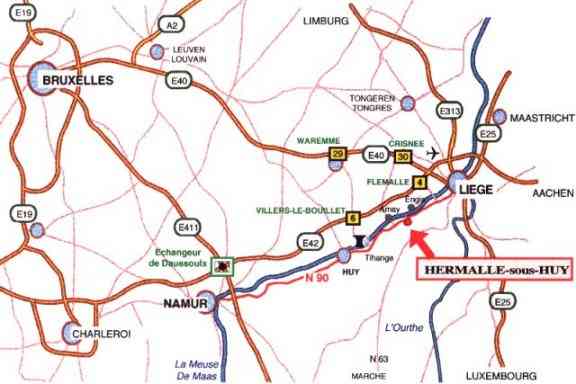
Hermalle-sous-Huy is in Wallonia (left south of Belgium, one of the countries of western Europe). The village is essentially situated on the right bank of Meuse, to 11 km downstream from Huy, 23 upstream from Liège, to 5 km of Tihange, 12 of Nandrin, 4 of Engis and 4 of Amay. Its territory stretches along the river, from West to East, from Ombret and Clermont-sous-Huy to Ehein. The village is crossed, in all its length, by the street Freddy Terwagne (portion of the N644), where are located most trades and, in the Farm castrale, the Tourist information office. Perpendicularly to this axis, the Rue du Pont starts from the old local house to head for the river (from where the old name "Rue de Meuse"). On the left, while descending the street, are the nursery and primary school, and an educational natural reserve; opposite, the Center of creativeness, the local Library and the Cultural Centre Camille Jamagne (asbl Centre culturel de l'entité engissoise). At the end of this street, on the bank of Meuse, an industrial activity park welcomes small and middle industries benefitting from various ways of transports (road, railroad n° 285 permitting a speed of 40 km/h on 1 way of 7,9 km, and fluvial harbor). 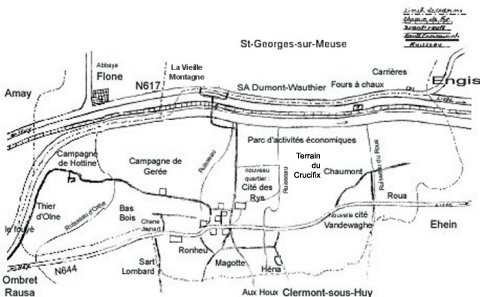
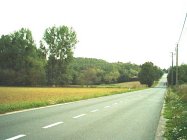
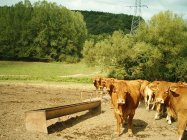
Hermalle-sous-Huy is in the major bed of Meuse, bed digged to the Tertiary between the hard layers of the limestones and carboniferous dolomites (360 to 300 millions years) on the right bank, and the more tender layers of the shales Silurian (495 to 400 millions years) and sandstones of the devonian (400 to 360 millions years). Meuse currently visible is recent: tertiary time - 40 millions years at more; it constituted itself by recession of the sources, from old river affluents (Hoyoux, Mehaigne, Geer, Ourthe, Meuse of Visé) that were consequent to the marine shore oscillating at the time around a line between Brussels, Tongeren and Maastricht. The coast that one recovers behind the village, and that goes up until the shelf of the Condroz, first permits to see, after having left the alluvial plain (and its recent alluviums of silts, sands and rolled stones), very old schist, greatly eroded, in gentle slope (until the fountain Saint-Martin, to the bottom of Oxhe, in the Thier d'Olne). It becomes steeper when it approaches the sandstone rocks, harder and therefore less eroded, and then the first rocks of the Condroz. Vegetation will have therefore an acidic type in the majority, with beechwood, bracken and blueberries. The construction of the fast way at the edge of Meuse in 1988 (that canalized the important road circulation), the steeply sided setting of the valley in direction of Ehein, the gentle slopes of meadows and woods toward Clermont-sous-Huy and Ombret, preserve fortunately a landscape where the broad-leaved trees border the verdant pastures.
|


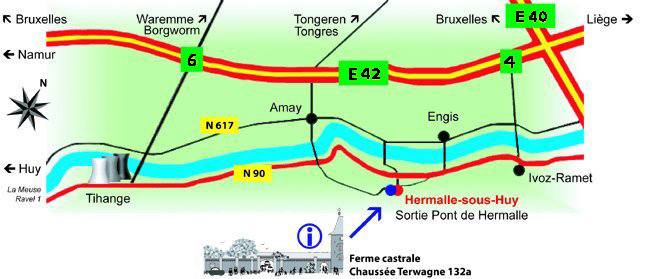 Road : N90, exit "Hermalle-sous-Huy - Pont
de Hermalle"
Road : N90, exit "Hermalle-sous-Huy - Pont
de Hermalle"
|
|
Tourist information
office, Ferme castrale, |
All year round Saturdays 2-7 pm & Sundays 11 am-7 pm |
| Gourmet Museum : |
Guided visits - Saturdays at 2, 4 & 6 pm, - Sundays at 11 am, 2, 4 & 6 pm, - Weekdays : on request for groups é Special access on request è Cars and coaches |
| Inn of the Museum : |
- Saturdays 2-7 pm & Sundays
11 am-7 pm - Weekdays : on request for groups |
|
Public Library : Gourmet Library : |
Monday 11-12am & 1-4.30pm,
Tuesday 1-4.30pm, Wednesday 4.30-7pm, Thursday 9-12am & 3.30-7pm
h, Saturday 9-12am - closed Friday & Sunday Only on request |
| Cultural centre : | Office : from Tuesday to Friday 8.30am-16.30pm |
| Shops : | click here |
 |
|
|
in the farm "Ferme Castrale" of Hermalle-sous-Huy province of Liège, between Liège and Huy, Wallonia, Belgium |