 A prestigious Past A prestigious Past
Toponymy :
The first traces of human occupation in the region are those of the " Man of Neanderthal " (40.000 at 25.000 years before Christ): imperfect biped, with bending of the knees and projection of the arms toward before, with voluminous and elongated skull, receding forehead and enormous arch of the eyebrow - carving the stone, living in a cold and humid climate.
In Hermalle-sous-Huy, some excavations revealed the man's presence to the locality "Thiers d'Olne" since the middle paleolithic; were recovered axes and carved flints. Toward 300-600 before Christ, the country of Gerée had to be occupied by Celts - what suppose the fragments of ceramics found in 2003 at the time of preventive polls achieved by the Walloon Region in the industrial activity park. In the second half of the 2d century and in the beginning of the 3d, one finds an establishment of Gallo-Roman tilemakers there.
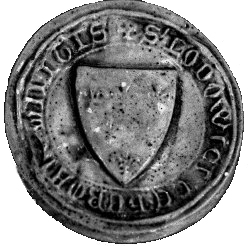
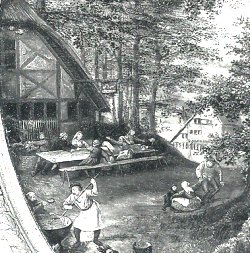
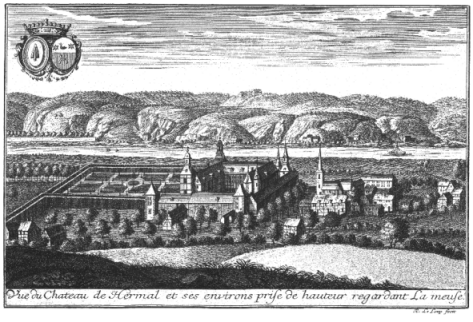
This aristocratic complex is the object of an important transformation during the 9th century. It consists then in a church and a vast Carolingian seigneurial edifice with domus, camerae, porches, storeroom, stable, etc. implanted to about twenty meters of distance of the church, bound to her by a wall limiting an interior court. This seigneurial center had to be abandoned - without traces of violent destruction - around the year thousand to the profit of another site on a hill, the rock of Engihoul (in Clermont-sousHuy). Hermalle-sous-Huy was the seat of one of the older lordships of the valley of Meuse coming under a feudal court since the Middle age and until the 18th century ; the history of the village coincides therefore with the one of its castle and its Lords... In the 12nd century, the present center of Hermalle-sous-Huy possesses a donjon surrounded with moat, surrounding walls and towers, of which one always subsists. In 1131, Giselbert d'Esch (son of countess Ermengarde de Clermont) resides in Hermalle; his direct descendants are then Renard de Hermalle, Henri de Hermalle, then Ruxela that marries Thomas deWarfusée sayed de Hermalle (grandson of Libert Suréal de Donmartin); their eldest son, Henri, will give birth to Louis de Hermalle, father of Henri II de Hermalle, marshal of the prince bishop of Liège and chief of the party of the Waroux, known for his exploits in the war of the Awans and the Waroux that ravages the region during 40 years and leads the destruction of the castle in 1315. Hardly rebuilds, the castle is destructed again in 1346. The domain, with the passing of the time, pass - by marriages or acquirements - to different families: de Lummen (by the marriage of Alix, girl of Henri II), de Salme, de Punch, de Rougrave, de Goisbeck, de Berlo... In the Middle Age, the population is ther to be everybody's beck and call; in the 13d century, poeple suffer the famine; similarly in the 15th century, where the pestilence reigns from Huy to Liège. In the 16th century, Lucas I Van Valckenborgh delivers us the pleasing picture of a feast in Hermalle, thick village with houses made of frame works and cobs, close to the church and on the hill :
In the 17th century, the Count d'Ursel makes to renovate and to
enlarge the castle,
in quarry stones of sandstone, chalky and bricks, with 2 cylindrical
towers to three levels and 2 square, horseshoe-shaped around
a court of honor - to which one reaches by the porch of the adjoining
ferme
castrale, bearing 1642 - and forbidden by a ditch filled
of water.
The beginning of this century
sees the reconstruction of the farme
of Hottine, at the foot of the Thiers d'Olne, and the construction
of the natal
house of Jean-Gilles Jacob to the bedhead of the church Saint-Martin;
the interior decoration of this building will be renewed by this
master-mason in 1753, on the occasion of his marriage, and presents
unique wall paintings in Europe.
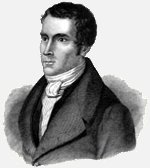
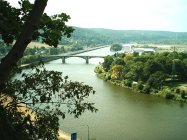
"Monsieur de Jacob" was also a surveyor, expert on oath for the court, alderman of the so-called court, holding the parochial church and alderman of Hermalle. One must him, presumably, another building of the village, the maison Sacré. In 1772, Jean-Joseph Hanson, poet and writer, was an other alderman of Hermalle-sous-Huy, before becoming professor in the academy of painting, sculpture and engraving founded to Liège by prince-bishop Velbrück, and before to be accepted like heraldist painter of the City of Liège and as official painter of the Saint-Lambert cathedral. The end of the century knows the risks of the French revolution (the villagers had to requisition the grains to not die of hunger) and its consequences that will concern the religious orders (as the one of the canons of Flône) more that the nobility that will keep her castles and her properties; she will however lose the right on the passages of water. In the 19th century, the seigneurial property, that belonged then to the family de Louvrex, then to the baron de Warzée de Hermalle, is sold (in 1853) to baron Charles de Potesta that installs rare trees in the park : redwoods, tulip tree of Virginia... and makes build the "Tower Malakoff" near the Meuse. This work will be demolished in 1938 at the time of the canalization of the river. The traditional small people habitat disappears to the profit of more comfortable houses in bricks and limestone, constructed along the main street (present street F. Terwagne). Masons and carpenters are the professions the more represented in Hermalle. The culture of the beet expends toward the middle of the century and some exploitations, as the Ferme castrale, will hire "foreign" seasonal workers (Pole or Flemish). From 1880 to 1895, the massive arrival of American wheats provokes a serious crisis that obliges number of small agriculturists of the region to try resources in the industry or even to enter into the campaigns of brickworks; women and children assume then the small exploitation load. The 20th century is marked by the misfortune: In January 1926, following torrential rains, Meuse overflows and completely floods the Chaumont district ; one will save the villagers but not the totality of livestock. The two World Wars bring as everywhere their share of suffering. Two plaques commemorate the memory of the heroes villagers, (one on the side of the old local house - Rue Wérihet, the other on the south side of the church Saint-Martin - place des Combattants) ; a third on the surrounding wall of the castle - chaussée F. Terwagne - recalls the death of a resistant shooted down by the German occupant whereas he tempted to escape the search of the Ferme castrale where he taked refuge. Event little-known (attested by the archives of the Gourmet Library), the "rexiste" (nazi) Léon Degrelle was the guest of the family de Potesta before the war. In the years '70, the agricultural activity generated by the castle stops; no project of profit for the buildings (transformation in centre of leisures or in convalescent home...) doesn't succeed. The descendants of Mr. de Potesta give up little by little their goods, earths and buildings, and the castle, today separated of its Ferme castrale, is not anymore property of no noble family. In the village, the builded space increases on both sides of the old center, all along the main street and encroaches little by little on the foothills of the Condroz plateau in direction of Clermont-sous-Huy, without too much cohesion as for the materials, plans and types of building. The population found use in the industry and the services. The agriculturist becames a minority. On January 1rst, Hermalle-sous-Huy disappears on the administrative plan: the fusion of the villages decided by the Belgian government reduces its territory (the part situated on the right bank of Meuse goes by the village of Saint-Georges-sur-Meuse) and includes it in the entity of Engis with the village of Clermont-sous-Huy and a part of Ehein. The village of Engis, where is centralized the administration, is situated on the right bank, to 4 km downstream; there is no direct transportation means between the 2 villages; the telephonic prefix is different (therefore the more elevated tariff) and, especially, the villagers don't have the same mentality, nor the same culture that those of Hermalle. During more of 20 years, the Hermalle's villagers will feel frustrated and somewhat neglected. Their old official archives are not more accessible for various reasons; they sometimes have the impression that they pass escapes them. In this month of January 2004, in spite of many efforts - of the Cultural Center notably -, the integration of the two populations is not always achieved. In spite of several demands since 10 years, it doesn't exist again in Engis roadsigns and markings that indicates Hermalle, and the drivers who don't know the region can turn easily in circle during 20 kilometers to find Hermalle so by misfortune they first surrendered in Engis...
The oral tradition says that in the Middle age, a man recognized guilty of a serious offense, was condemned to death by the Lord of Hermalle, who had right of high and low justice. The executioner was going to pass him the rope to the neck before the all population when emerges a rider announcing the grace. The Lord himself came to specify that he forgave because of an happy event just occurred at the castle, and that a mass would be celebrated the following Sunday to thank God of it. He added that in to remember this day, the festivities would take place of year in year, Sunday that would follow July 16. Legend? Believable however, since Hermalle had its judicial court... However that may be, the Feast of the Big Forgiveness of Hermalle respects the tradition and is held the weekend that follows July 16...See the agenda !
Saumery, le château de Hermal in Les Délices du Païs de Liège, Liège, 1738 Pety de Thozee (Jules), Le fief de Cassal à Hermalle-sous-Huy, in Chronique archéologique du pays de Liège, 1910 Collectif, Hermalle-sous-Huy in Les Sites mosans de Lucas I et Martin I Van Valckenborgh, Ed. Sté royale des Beaux-Arts de Liège, Liège, 1954 Lemeunier (A.), La Maison de Jean-Gille Jacob in La Maison d'Hier et d'Aujourd'hui, Ed. Association royale des Demeures historiques de Belgique, 1974 Bolly (J-J.), Hermalle-sous-Huy in Répertoire photographique du mobilier des sanctuaires de Belgique - Province de Liège canton de Huy I, Ministère de la culture française, Bruxelles, 1975 Collectif, Hermalle-sous-Huy - Monographie, Ed. Asbl Foyer culturel d'Hermalle-sous-Huy, 1981 Collectif, Hermalle-sous-Huy in Le Patrimoine monumental de la Belgique, Ed. Pierre Mardaga, Liège, 1992, T. 16/1, pp. 355-372 [Hanot (Nicole)], Hermalle-sous-Huy Village des Antiquités, de la Brocante et des Arts - Circuit du Patrimoine, Ed. Hermalle-sous-Huy VAP, Engis, 1994 Collectif, Hermalle-sous-Huy in Bulletins du Cercle Archéologique Hesbaye-Condroz asbl, Amay Flagothier (Jean), Hermalle-sous-Huy in Si Clermont était conté..., Ed. Jean Flagothier, 1995 Verstraeten (Jacques), Moreau (Claire) et Charles-Xavier Ménage, la Ferme castrale d'Hermalle-sous-Huy in Le Patrimoine rural du Pays d'Amay, Ed. Ministère de la Région wallonne, 1996 Lemonnier (Arlette) & Cl. Marlaire, le Pont de Hermalle-sous-Huy - la Ferme castrale d'Hermalle-sous-Huy in Ponts d'hier et d'aujourd'hui - Le Pays hutois, Ed. MET, 1999 Baar (Armand), Hermalle-sous-Huy in A propos des bouteilles armoriées liégeoises, Liège, Imp. centrale, s.d. de Meester de Betzenbroeck (Hervé), Épigraphie de la Hesbaye hutoise, Sté des Bibliophiles, sl, 1975 Forrest (Alan), Napoleon's MenThe Soldiers of the Revolution and Empire, Continuum International Publishing Group, 2002 Torfs (Louis), Fastes des calamités publiques survenues dans les Pays-Bas et particulièrement en Belgique depuis les temps les plus reculés jusqu’à nos jours, 1859 Marchal J.-P. et S. Loicq, Engis/Hermalle-sous-Huy : sondages d'évaluation dans le parc industriel, in Chronique de l'Archéologie wallonne 12, 2006, p. 141-143 Christian Frébutte et Michèle Gustin, Engis/Hermalle-sous-Huy : fouille de prévention dans la zone d'actvité économique, in Chronique de l'Archéologie wallonne 13, 2006, p. 159-161 Christian Frébutte et Michèle Gustin, Engis/Hermalle-sous-Huy : fouille d'une installation protohistorique et d'une tuilerie gallo-romaine à la « Campagne de la Gerée », in Chronique de l'Archéologie wallonne 14, 2006, p. 129-131 Christian Frébutte, Michèle Gustin, J.-.P. Marchal, Olivier Collette, Ann Defgnée et Christine Laurent : Occupation du Hallstatt C à la « Campagne de la Gerée », à Hermalle-sous-Huy (Province de Liège), Lunula, Archaeologia protohistorica, XV, 2007, p. 97-105 Christian Frébutte, Michèle Gustin, J.-.P. Marchal, Olivier Collette, Ann Defgnée et Christine Laurent : Engis/Hermalle-sous-Huy : fin de la fouille de prévention à la « Campagne de la Gérée », in Chronique de l'Archéologie wallonne 15, 2008, p. 120-122 .
Considering the disappearance of a big part of the local archives in the years 1980, we would not have been able, without their help, to reconstitute some elements of the recent history of the village. It goes without saying that we are always in search of old documents about Hermalle. Contact : info@hermalle-sous-huy.be. |

|
|
|
in the farm "Ferme Castrale" of Hermalle-sous-Huy province of Liège, between Liège and Huy, Wallonia, Belgium |